February 2026
February 27, 2026
Lang, Alegebra Chapter 19. The Alternating Product.
The alternating product has applications throughout mathematics. In differential geometry, one takes the maximal alternating product of the tangent space to get a canonical line bundle over a manifold. Intermediate alternating products give rise to differential forms (sections of these products over the manifold.) In this chapter, we give the algebraic background for these constructions.
Section 1. Definition and Basic Properties.
Consider the category of modules over a commutative ring \(R\).
We recall that an \(r\)-multilinear map \(f: E^{(r)} \to F\) is said to be alternating if \(f(x_1, \cdots, x_r) = 0\) whenever \(x_i = x_j\) for some \(i \ne j\).
Let \(\mathfrak{a}_r\) be the submodule of the tensor product \(T^{r}(E)\) generated by all elements of type \[x_1 \otimes \cdots \otimes x_r\] where \(x_i = x_j\) for some \(i \ne j\).
(What does this mean? See page 129 Lang (2002) for the definition of a submodule generated by a subset.)
We define \[\bigwedge^r (E) = T^r(E)/ \mathfrak{a}_r.\]
Then we have an \(r-\)multilinear map \(E^{(r)} \to \bigwedge^r (E)\) (called canonical) obtained from the composition \[E^{(r)} \to T^r(E) \to T^r(E)/ \mathfrak{a}_r = \bigwedge^r(E).\]
February 26, 2026
I can probably tackle the beginning of section 3 of Chatterjee (2016) with Lang’s Algebra and Chapter 1 of Mirror Symmetry, which covers Hodge Star, Curvature form, and more, in 25 pages or so, but at a very advanced level, with much of the algebra taken for granted.
February 24, 2026
I’m going to type out the rest of Serre (1965) Chapter 1: Lie Algebras: Definitions and Examples.
Examples.
Let \(k\) be a complete field with respect to an absolute value, let \(G\) be an analytic group over \(k\), and let \(\mathfrak{g}\) be the set of tangent vectors to \(G\) at the origin. There is a natural structure of a Lie algebra on \(\mathfrak{g}\).
Let \(\mathfrak{g}\) be any \(k\)-module. Define \([x,y] = 0\) for all \(x, y \in \mathfrak{g}\). Such a \(\mathfrak{g}\) is called a commutative Lie Algebra.
If in the preceding example we take \(\mathfrak{g} \oplus \bigwedge^2 \mathfrak{g}\) and define \[[x,y] = x \wedge y\] \[[x, y \wedge z] = 0\] \[[x \wedge y, z] = 0\] \[[x \wedge y, z \wedge t] = 0\] for all \(x,y,z,t \in \mathfrak{g}\), then \(\mathfrak{g} \oplus \bigwedge^2 \mathfrak{g}\) is a Lie algebra.
Let \(A\) be an associative algebra over \(k\) and define \([x,y] = xy - yx\), for all \(x,y \in A\). Clearly \(A\) with this product satisfies the axioms 1) and 2).
Definition 2. Let \(A\) be an algebra over \(k\). A derivation \(D: A \to A\) is a \(k\)-linear map with the property \(D(x \cdot y) = Dx \cdot y + x \cdot Dy\).
- The set \(\text{Der}(A)\) of all derivations of an algebra \(A\) is a Lie algebra with the product \([D,D'] = DD' - D'D\). We will prove this by computation: \[\begin{align*} [D,D'](x \cdot y) &= DD'(x \cdot y) - D'D(x \cdot y) \\ &= D(D'x \cdot y + x \cdot D'y) - D'(Dx \cdot y + x \cdot Dy) \\ &= DD'x \cdot y + D'x \cdot Dy + Dx \cdot D'y + x \cdot DD'y \\ &- D'Dx \cdot y - Dx \cdot D'y - D'x \cdot Dy - x D'Dy \\ &= DD'x \cdot y + x \cdot DD'y - D'Dx \cdot y - x \cdot D'Dy \\ &= [D,D'] x \cdot y + x \cdot [D,D'] y. \end{align*}\]
Theorem 3. Let \(\mathfrak{g}\) be a Lie algebra. For any \(x \in \mathfrak{g}\) define a map \(\text{ad}x: \mathfrak{g} \to \mathfrak{g}\) by \[\text{ad}x(y) = [x,y],\] then
\(\text{ad}x\) is a derivation of \(\mathfrak{g}\).
The map \(x \mapsto \text{ad}x\) is a Lie homomorphism of \(\mathfrak{g}\) into \(\text{Der}(\mathfrak{g})\).
Proof. \[\begin{align*} \text{ad}x[y,z] &= [x,[y,z]] \\ &= -[y,[z,x]] - [z,[x,y]] \\ &= [[x,y],z] + [y,[x,z]] \\ &= [\text{ad}x(y), z] + [y, \text{ad}x(z)], \end{align*}\] hence 1. is equivalent to the Jacobi identity.
Now \[\begin{align*} \text{ad}[x,y](z) &= [[x,y],z] \\ &= -[[y,z],x] - [[z,x],y] \\ &= [x,[y,z]] - [y,[x,z]] \\ &= \text{ ad}x \text{ ad}y(z) - \text{ ad}y \text{ ad} x(z) \\ &= [\text{ ad}x, \text{ ad}y](z), \end{align*}\] hence (2) is also equivalent to the Jacobi identity.
- The Lie Algebra of an algebraic matrix group.
Let \(k\) be a commutative ring and let \(A = M_n(k)\) be the algebra of \(n \times n\) matrices over \(k\). Given a set of polynomials \(P_\alpha(X_{ij})\) for \(1 \le i,j \le n\), a zero of \((P_\alpha)\) is a matrix \(x = (x_{ij})\) such that \(x_{ij} \in k\) and \(P_\alpha(x_{ij}) = 0\) for all \(\alpha\).
Let \(G(k)\) denote the set of zeroes of \((P_\alpha)\). If \(k'\) is any associative, commutative \(k\)-algebra, we have analogously that \(G(k') \subset M_n(k')\).
Definition 4. The set \((P_\alpha)\) defines an algebraic group over \(k\) if \(G(k')\) is a subgroup of \(GL_n(k')\) for all associative, commutative \(k\)-algebras \(k'\).
The orthogonal group is an example of an algebraic group (equation: \(X^t \cdot X = 1\).)
Now let \(k'\) be the \(k\)-algebra which is free over \(k\) with basis \(\{1, \epsilon \}\) where \(\epsilon^2 = 0\), i.e., \(k' = k[\epsilon]\).
Theorem 5. Let \(\mathfrak{g}\) be the set of matrices \(X \in M_n(k)\) such that \(1 + \epsilon X \in G(k[\epsilon])\). Then \(\mathfrak{g}\) is a Lie subalgebra of \(M_n(k)\).
Proof. We have to prove that \(X, Y \in \mathfrak{g}\) implies that \(\lambda X + \mu Y \in \mathfrak{g},\) for \(\lambda, \mu \in k\) and \(XY - YX \in \mathfrak{g}\).
To prove that, note first that \[P_{\alpha} (1 + \epsilon X) = 0 \text{ for all } \alpha \Leftrightarrow X \in \mathfrak{g}\] and since \(\epsilon^2 = 0\), we have \[P_\alpha(1 + \epsilon X) = P_\alpha(1) + dP_\alpha(1) \epsilon X.\] But \(1 \in G(k)\), i.e. \(P_\alpha(1) = 0\); therefore \[P_{\alpha}(1 + \epsilon X) = dP_\alpha(1) \epsilon X.\] Hence, \(\mathfrak{g}\) is a submodule of \(M_n(k)\).
We introduce now an auxilliary algebra \(k''\) given by \(k'' = [\epsilon, \epsilon', \epsilon'\epsilon]\) where \(\epsilon^2 = \epsilon'^2 = 0\) and \(\epsilon' \epsilon = \epsilon \epsilon'\), i.e., \(k'' = k[\epsilon] \otimes_k k[\epsilon']\).
Let \(X,Y \in \mathfrak{g}\), so we have \[g = 1+ \epsilon X \in G(k[\epsilon]) \subset G(k'')\] \[g' = 1 + \epsilon' Y \in G(k[\epsilon']) \subset G(k'')\] \[gg' = (1 + \epsilon X)(1 + \epsilon' Y) = 1 + \epsilon X + \epsilon Y' + \epsilon \epsilon' XY\] \[g'g = 1 + \epsilon X + \epsilon' Y + \epsilon \epsilon' YX.\]
Write \(Z = [X,Y]\); \[gg' = g'g(1+\epsilon \epsilon' Z).\] Since \(gg', g'g \in G(k'')\), it follows that \[1 + \epsilon \epsilon' Z \in G(k'').\] But the subalgebra \(k[\epsilon \epsilon']\) of \(k''\) may be identified with \(k[\epsilon]\). It then follows that \(1 + \epsilon Z \in G(k[\epsilon])\), hence \(Z \in \mathfrak{g}\). q.e.d.
Example. The Lie Algebra of the orthogonal group is the set of matrices \(X\) such that \((1 + \epsilon X) (1 + \epsilon X^t) = 1\), i.e., \(X + X^t = 0\).
February 23, 2026
Tensor and Exterior Algebras
I’m just going to type out the beginning of Chapter 2 of Warner (2000).
Let \(V\), \(W\), and \(U\) denote finite dimensional real vector spaces. \(V^*\) will denote the dual space of \(V\) consisting of all real-valued linear functions on \(V\).
Let \(F(V,W)\) be the free vector space over \(\mathbb R\) whose generators are the points of \(V \times W\). Thus, \(F(V,W)\) consists of all finite linear combinations of pairs \((v,w)\) with \(v \in V\) and \(w \in W\). Let \(R(V,W)\) be the subspace of \(F(V,W)\) generated by the set of all elements of \(F(V,W)\) of four distinct forms.
\[(v_1 + v_2, w) - (v_1, w) - (v_2, w)\] \[(v,w_1 + w_2) - (v,w_1) - (v,w_2)\] \[(av,w) - a(v,w)\] \[(v,aw) - a(v,w)\]
for \(v, v_1, v_2 \in V\) and \(w, w_1, w_2 \in W\) and \(a \in \mathbb R\).
The quotient space \(F(V,W)/R(V,W)\) is called the tensor product of \(V\) and \(W\) and is denoted by \(V \otimes W\). The coset of \(V \otimes W\) containing the element \((v,w)\) of \(F(V,W)\) is denoted by \(v \otimes w\). It follows from the form of the elements in \(R(V,W)\) that we have the following identities in \(V \otimes W\):
\[(v_1 + v_2) \otimes w = v_1 \otimes w + v_2 \otimes w\] \[v \otimes (w_1 + w_2) = v \otimes w_1 + v \otimes w_2\]
\[a(v \otimes w) = av \otimes w = v \otimes aw.\]
The following properties of the tensor product can be established, as exercises.
- Universal mapping property. Let \(\phi\) denote the bilinear map \((v,w) \mapsto v \otimes w\) of \(V \times W\) into \(V \otimes W\). Then whenever \(U\) is a vector space and \(l: V \times W \to U\) is a bilinear map, there exists a unique linear map \(\tilde{l}: V \otimes W \to U\) such that \[l = \tilde{l} \circ \phi.\] The pair consisting of \(V \otimes W\) and \(\phi\) is said to solve the universal mapping problem for bilinear maps with domain \(V \times W\). Moreoever, \(V \otimes W\) and \(\phi\) are unique with this property in the sense that if \(X\) is a vector space and \(\tilde{\phi} V \times W \to X\) a bilinear map with the above universal mapping property, then there exists an isomorphism \(\alpha: V \otimes W \to X\) such that \(\alpha \circ \phi = \tilde{\phi}\).
Proof
Note that \((v \otimes w)_{(v,w) \in V \times W}\) generates \(V \otimes W\). Let \(x \in V \otimes W\) be arbitrary. Then \(x = \sum_{i=1}^n a_i(v_i \otimes w_i)\) for some \(a_i \in \mathbb R\), and \((v_i,w_i) \in V \times W\). For \(v \otimes w \in V \otimes W\), define \(\tilde{l}(v \otimes w) = l(v,w)\). Then extend by linearity to an abitrary \(x\) by: \[ \tilde{l}(x) := \sum_{i=1}^n a_i l(v_i,w_i). \]
\(V \otimes W\) is canonically isomorphic to \(W \otimes V\).
\(V \otimes (W \otimes U)\) is canonically isomorphic with \((V \otimes W) \otimes U\).
By property (a), the bilinear map of \(V^* \times W\) into the vector space \(Hom(V,W)\) of linear transformations from \(V\) to \(W\) defined by \[V^* \times W \ni (f,w) \mapsto (V \ni v \mapsto f(v)\cdot w \in W) \in Hom(V,W)\] determines uniquely a linear map \(\alpha: V^* \otimes W \to Hom(V,W)\). \(\alpha\) is an isomorphism. As a consequence \[ \dim V \otimes W = (\dim V)(\dim W). \]
Proof
\(\alpha\) is defined similarly as in (a). We must find a linear map (morphism of vector spaces) \(g: Hom(V,W) \to V^* \otimes W\) such that \(\alpha \circ g = I \in \text{Mor}(\text{Hom}(V,W),\text{Hom}(V,W))\) and \(g \circ \alpha = I \in \text{Mor}(V^* \otimes W, V^* \otimes W).\)
Let \(v_1, \cdots, v_n\) and \(w_1, \cdots, w_k\) be bases for \(V\) and \(W\) respectively. Let \(f_1, \cdots, f_n\) be the dual basis of \(V^*\) with respect to \(v_1, \cdots, v_n\). By Theorem 4.1 Lang Algebra, for each \(i \in [n]\) and \(j \in [m]\), there is a unique linear map \(f_{ij}: V \to W\) such that \[ f_{ij}(v_l) = \begin{cases} w_j & \text{ if l = i} \\ 0 & \text{ if } l \ne i. \end{cases} \] In other words, \(f_{ij}\) maps \(v_i\) to \(w_j\) and otherwise sends the other basis elements of \(V\) to \(0 \in W\). Then \(f_{ij}\) can be written in terms of the dual basis as \[f_{ij}(x) = f_i(x)w_j,\] for any \(x \in V\).
Now let \(g: Hom(V,W) \to V^* \otimes W\) map \(f_{ij} = f_i \cdot w_j\) to \(f_i \otimes w_j\), and extend by linearity to the rest of \(\text{Hom}(V,W)\).
Then for \(\sum_i x_i (d_i \otimes w_i)\) where \(x_i \in \mathbb R\), \(d_i \in V^*\), and \(w_i \in W\) are arbitrary for \(i \in [k]\) for some \(k\), we have that \[\begin{align*} g \circ \alpha (\sum_i x_i (d_i \otimes w_i)) &= \sum_i x_i g \circ \alpha(d_i \otimes w_i) \\ &= \sum_i x_i g \circ \alpha(\sum_l d_{il}f_l \otimes \sum_m w_{im} w_m)\\ &= \sum_i x_i g \circ \alpha(\sum_{l,m} d_{il} w_{im} (f_l \otimes w_m))\\ &= \sum_i x_i \sum_{l,m} d_{il} w_{im} g \circ \alpha (f_l \otimes w_m) \\ &= \sum_i x_i \sum_{l,m} d_{il} w_{im} g (f_{lm}) \\ &= \sum_i x_i \sum_{l,m} d_{il} w_{im} (f_l \otimes w_m) \\ &= \sum_i x_i (d_i \otimes w_i). \end{align*}\]
- Let \(\{e_i: i = 1, \cdots, c\}\) and \(\{f_j: j = 1, \cdots, d\}\) be bases for \(V\) and \(W\) respectively. Then \(\{e_i \otimes f_j: i = 1, \cdots, c \text{ and } j = 1, \cdots, d\}\) is a basis of \(V \otimes W\).
Further definitions. The tensor space \(V_{r,w}\) of type \((t,s)\) associated with \(V\) is the vector space \[ V \otimes \cdots \otimes V \otimes V^* \otimes \cdots \otimes V^* \] with \(r\) copies of \(V\) and \(s\) copies of \(V^*\). The direct sum \[ T(V) = \sum_{r,s \ge 0} V_{r,s}, \] where \(V_{0,0} = \mathbb R\) is called the tensor algebra of \(V\). Elements of \(T(V)\) are finite linear combinations over \(\mathbb R\) of elements of the various \(V_{r,s}\) and are called tensors. \(T(V)\) is a non-commutative, associative, graded algebra under \(\otimes\) multiplication, where if \(u = u_1 \otimes \cdots \otimes u_{r_1} \otimes u_1^* \otimes \cdots \otimes u_{s_1}^*\) belongs to \(V_{r_1, s_1}\) and \(v = v_1 \otimes \cdots \otimes v_{r_2} \otimes v_1^* \otimes \cdots \otimes v_{s_2}^*\) belongs to \(V_{r_2, s_2}\), then there product \(u \otimes v\) is defined by \[ u \otimes v = u_1 \otimes \cdots \otimes u_{r_1} \otimes v_1 \otimes \cdots \otimes v_{r_2} \otimes u_1^* \otimes \cdots \otimes u_{s_1}^* \otimes v_1^* \otimes \cdots \otimes v_{s_2}^* \] and belongs to \(V_{r_1 + r_2, s_1 + s_2}\). Tensors in a particular tensor space \(V_{r,s}\) are called homogeneous of degree \((r,w)\). A homogeneous tensor (of degree (r,s) say) is called decomposable if it can be written in the form \[ v_1 \otimes \cdots \otimes v_r \otimes v_1^* \otimes \cdots \otimes v_2^* \] where \(v_i \in V\) and \(v_j^* \in V^*\).
Definitions. We let \(C(V)\) denote the subalgebra \(\sum_{k = 0}^\infty V_{k,0}\) of \(T(V)\). Let \(I(V)\) be the two-sided ideal in \(C(V)\) generated by the set of elements of the form \(v \otimes v\) for \(v \in V\), and set \[ I_k(V) = I(V) \cap V_{k,0}. \]
What is meant by two-sided ideal generated by elements of the form \(v \otimes v\)?
In the section Rings and Homomorphisms in Lang (2002), the following is written. If \(A\) is a ring and \(a \in A\), then \(AaA\) is a principal two-sided ideal if we define \(AaA\) to be the set of all sums \(\sum x_i a y_i\) with \(x_, y_i \in A\). Cf. below the definition of the product of ideals.
It follows that \[ I(V) = \sum_{k=0}^{\infty} I_k(V), \] and is a graded ideal in \(C(V)\). The exterior algebra \(\Lambda(V)\) of \(V\) is the graded algebra \(C(V) / I(V).\) If we set \[ \Lambda_k(V) = V_{k,0} / I_k(V) \] for \(k \ge 2\) and \(\Lambda_0(V) = \mathbb R\) and \(\Lambda_1(V) = V\), then \[ \Lambda(V) = \sum_{k=0}^\infty \Lambda_k(V). \] We shall denote multiplication in the algebra \(\Lambda(V)\) by \(\wedge\). This is called the wedge or exterior product. In particular, the residue class containing \(v_1 \otimes \cdots \otimes v_k\) is \(v_1 \wedge \cdots \wedge v_k\).
Definition. A multilinear map \(h: V \times \cdots \times V \to W\) with \(r\) copies of \(V\) is called alternating if \(h(v_{\pi(1)}, \cdots, v_{\pi(r)}) = (Sgn \pi)h(v_1, \cdots, v_r)\) for all permutations \(\pi\) in the permutation group \(S_r\) on \(r\) letters. \(Sgn \pi\) is the sign of the permutation \(\pi\) (+1 if \(\pi\) is even and -1 if \(\pi\) is odd). The vector space of all alternating multilinear functions \(V \cdots V \to \mathbb R\) with \(r\) copies of \(V\) will be denoted by \(A_r(V)\), and for convenience we set \(A_0(V) = \mathbb R\).
2.6. The following properties of the exterior algebra can be proven as exercises.
If \(u \in \Lambda_k(V)\) and \(v \in \Lambda_l(V)\), then \(u \wedge v \in \Lambda_{k+l}(V)\) and \(u \wedge v = (-1)^{kl} v \wedge u\).
If \(e_1, \cdots, e_d\) is a basis of \(V\), then \[\{e_\Phi \}\] is a basis of \(\Lambda(V)\), where \(\Phi\) runs over all subsets of \(\{1,\cdots, d\}\), including the empty set; where \(e_\Phi = e_{i_1} \wedge \cdots \wedge e_{i_r}\) with \(i_1 < \cdots < i_r\) where \(\Phi\) is the subset \(\{i_1, \cdots, i_r\}\) of \(\{1, \cdots, d\}\); and where \(e_{\Phi} = 1\) when \(\Phi = \emptyset\). In particular, \[\Lambda_d(V) \cong \mathbb R\] and \[\Lambda_{d+j}(V) = \{0\} \] for \(j > 0\). Moreover, it follows that \[\dim \Lambda(V) = 2^d,\] \[\dim \Lambda_k(V) = \binom{d}{k} = \frac{d!}{k!(d-k)!}\] where \(0 \le k \le d\).
(Hint: Observe that the elements \(\{e_\Phi \}\) span \(\Lambda(V)\). To prove that they are also linearly independent, first prove that \(e_1 \wedge \cdots \wedge e_d\) is not zero in \(\Lambda_d(V)\). For this, one must show that \(e_1 \otimes \cdots \otimes e_d\) does not belong to \(I(V)\). Express an arbitrary element of \(I(V)\) in terms of the basis vectors \(e_1, \cdots, e_d\), and show that it could not equal \(e_1 \otimes \cdots \otimes e_d\). Then for the linear independence of the entire set \(\{e_\Phi\}\), multiply the equation \(\sum a_\Phi e_\Phi = 0\) by suitable products of the \(e_i\) to land in \(\Lambda_d(V)\), and conclude that the various \(a_\Phi\) are all zero.)
Proof
Let’s first show that \(e_1 \wedge e_2 = -e_2 \wedge e_1\). Let \(R\) be the submodule of \(E \otimes E\) generated by elements of the form \(v \otimes v\) for \(v \in E\). We want to show that \(e_1 \otimes e_2 + R = -e_2 \otimes e_1 + R\). Hence, we want to show that \(e_1 \otimes e_2 - (-e_2 \otimes e_1) \in R\). Inspired by the fact that we can choose other respresentatives besides \(e_1 \otimes e_2\) and \(e_2 \otimes e_1\), we consider the element \((e_1 + e_2) \otimes (e_1 + e_2) \in R\). It is equal to \(e_1 \otimes e_1 + e_1 \otimes e_2 + e_2 \otimes e_1 + e_2 \otimes e_2\). Since we only want the mixed terms, it suggest to substract out \(e_1 \otimes e_1\) and \(e_2 \otimes e_2\). Then we have \[\begin{align*} e_1 \otimes e_2 + e_2 \otimes e_1 &= (e_1 + e_2) \otimes (e_1 + e_2) \\ & - e_1 \otimes e_1 - e_2 \otimes e_2 \in R, \end{align*}\] since the latter is indeed a linear combination of elements of the form \(v \otimes v\). Thus we have shown that \(e_1 \wedge e_2 = -e_2 \wedge e_1.\)
- Universal Mapping Property. Let \(\phi\) denote the mapping \((v_1, \cdots, v_k) \mapsto v_1 \wedge \cdots v_k\) of \(V \times \cdots \times V\) (\(k\) copies) into \(\Lambda_k(V)\). Then \(\phi\) is a an alternating multilinear map. Now to each alternating multilinear map \(h\) of \(V \times \cdots \times V\) (\(k\) copies) into a vector space \(W\), there corresponds uniquely a linear map \(\tilde{h}: \Lambda_k(V) \to W\) such that \[ \tilde(h) \circ \phi = h. \] The pair consisting of \(\Lambda_k(V)\) and \(\phi\) is said to solve the universal mapping problem for alternating multilinear maps with domain \(V \times \cdots \times V;\) and this is the unique solution in the sense that if \(X\) is a vector space and \(\tilde{\phi}: V \times \cdots \times V \to X\) an alternating multilinear map also possessing the universal mapping property for alternating multilinear maps with domain \(V \times \cdots \times V\), then there is an isomorphism \(\alpha: \Lambda_k(V) \to X\) such that \(\alpha \circ \phi = \tilde{\phi}\).
In the special case in which \(W = \mathbb R\), the diagram given by the relation \(\tilde(h) \circ \phi = h\) establishes a natural isomorphism \[ \Lambda_k(V)^* \cong A_k(V) \] of \(\Lambda_k(V)^*\) with the vector space \(A_k(V)\) of all alternating multilinear functions on \(V \times \cdots \times V\) (\(k\) copies). It follows from property (b) that \(A_k(V) = \{0\}\) for \(k > \dim V\).
Serre’s defintion of a Lie Algebra
Let \(k\) be a commutative ring with unit element. Let \(A\) be a \(k\)-module. Then \(A\) is said to be a \(k\)-algebra if there is given a \(k\)-bilinear map \(A \times A \to A\). In other words, there is a \(k\)-homomorphism \[A \otimes_{k} A \to A.\]
Definition 1. A Lie Algebra over \(k\) is an algebra with the following two properties. The first property is as follows. The map \[A \otimes_k A \to A\] admits a factorization \[A \otimes_k A \to \bigwedge^2 A \to A.\] In other words, if we denote the image of \((x,y)\) by \([x,y]\) under this map, then the condition becomes \[ [x,x] = 0 \] for all \(x \in A\).
Why?
Denote the conanical injection \(k\)-linear map \(A \otimes_k A \to \bigwedge^2 A\) by \(\phi\). Denote the \(k\)-linear map \(\bigwedge^2 A \to A\) by \(g\), and denote the \(k\)-linear map \(A \otimes_k A \to A\) by \(f\). That \(f\) admits a factorization means that \[ f = g \circ \phi. \] Now fix \((x,x) := x \otimes x \in A \otimes_k A\), and we want to show that \([x,x] = f(x,x) = 0\). Recall that \(\bigwedge^2 A\) is the factor module of \(A \otimes_k A\) by the free submodule generated by elements of the form \(v \otimes v\). Recall also that \(v \wedge w\) denotes the equivalence class containing \(v \otimes w\). By definition of factor module, \(0 = v \wedge v \in \bigwedge^2 A\). Hence, from \(g(0) = 0\) by linearity, we know that \(g(v \wedge v) = 0\). Observe: \[\begin{align*} f(x \otimes x) &= g(\phi(x \otimes x)) \\ &= g(x \wedge x)\\ &= 0, \end{align*}\] as desired.
The second property is as follows. \[ [[x,y],z] + [[y,z],x] + [[z,x],y] = 0 \] which is known as Jacobi’s identity.
Warner’s Definition of a Lie Algebra
A Lie Algebra \(\mathfrak{g}\) over \(\mathbb R\) is a real vector space \(\mathfrak{g}\) together with a bilinear operator \([ , ]: \mathfrak{g} \times \mathfrak{g} \to \mathfrak{g}\) (called the bracket) such that for all \(x,y, z \in \mathfrak{g}\),
- \([x,y] = -[y,x]\) (anti-commutativity)
- \([[x,y],z] + [[y,z],x] + [[z,x],y] = 0\) (Jacobi identity)
Real or Complex vector spaces?
I’m a bit confused why real Lie Algebras are considered and not complex ones. Let me reason through the following example. Note that \(\mathfrak{gl}(n, \mathbb C)\) is the \(2n^2\)-dimensional (real) Lie Algebra obtained by endowing \(M(n, \mathbb C)\) with the commutator bracket according to Lee (2013).
Viewed as a complex vector space, \(M(n, \mathbb C)\) is \(n^2\) dimensional, because it has a basis of the \(n^2\) matrices given by putting 1 at one entry and 0 at all other entries. If \(T\) is an arbitrary complex matrix with \(n^2\) entries, then you can see that the aforementioned basis is truly a basis by decomposing \(T\) into a real part and an imaginary part, and then proceeding in the obvious way.
On the other hand, viewed as a real vector space, \(M(n, \mathbb C)\) is \(2n^2\) dimensional. This time a possible basis is \((\delta_{k,l})_{k,l \in [n]}\) concatenated with \((\sqrt{-1} \delta_{k,l})_{k,l \in [n]}\).
February 20, 2026
Notes on Chatterjee Leading Term paper
I want to compute the matrix of the form \(M_n^0\) in some simple cases. Note that \(M_n^0: \mathbb R^{E_n^1} \times \mathbb R^{E_n^1} \to \mathbb R\), and the matrix to \(M_n^0\), denote it \(l_n^0\), satisfies \(l_n^0 : E_n^1 \times E_n^1 \to \mathbb R.\) Note that this is a slightly ambiguous definition of a matrix because we haven’t defined an ordering on the edges. This will become important for defining a determinant of \(l_n^0\). Furthermore, the matrix to the form satisfies \[l_n^0(e_i, e_j) = M_n^0(1_{e_i}, 1_{e_j}),\] where \(1_{e_j} : E_n^1 \to \mathbb R\) is given by \[ 1_{e_j}(e) = \begin{cases} 1 & \text{if }e = e_j\\ 0 & \text{if }e \ne e_j \end{cases} \] for all \(e \in E_n^1\). Recall also that \[M_n^0(t,s) = \sum_{p \in \mathcal{P}} t(p) s(p)\] for \((t,s) \in \mathbb R^{E_n^1} \times \mathbb R^{E_n^1}\), where \(t(p) = t(p^{1}) + t(p^{2}) - t(p^{3}) - t(p^{4})\), where \(p\) is a plaquette and \(p^i\) are the positively oriented edges comprising the plaquette. Note also that \(M_n^0\) is symmetric: \[ M_n^0(t,s) = M_n^0(s,t). \]
When \(n=4\), the matrix to \(M_4^0\) is a \(9\) by \(9\) matrix because there are \(9\) edges in \(E_4^1\). When \(n=3\), the matrix to \(M_3^0\) is a \(4\) by \(4\) matrix because there are \(4\) edges in \(E_3^1\). In this case, by symmetry, we need to compute \(10\) entries of a \(16\) entry matrix.
Thus, let’s compute \(l_3^0\). So we consider the box \(B_3\). Let \[e_1 = ((0,1),(1,1))\] \[e_2 = ((1,1),(2,1))\] \[e_3 = ((0,2),(1,2))\] \[e_4 = ((1,2),(2,2))\] be shorthand notation for the edges in \(E_3^1\). The plaquettes are \[p_1 = ((0,0), 1,2)\] \[p_2 = ((1,0), 1,2)\] \[p_3 = ((0,1), 1,2)\] and \[p_4 = ((1,1), 1,2).\]
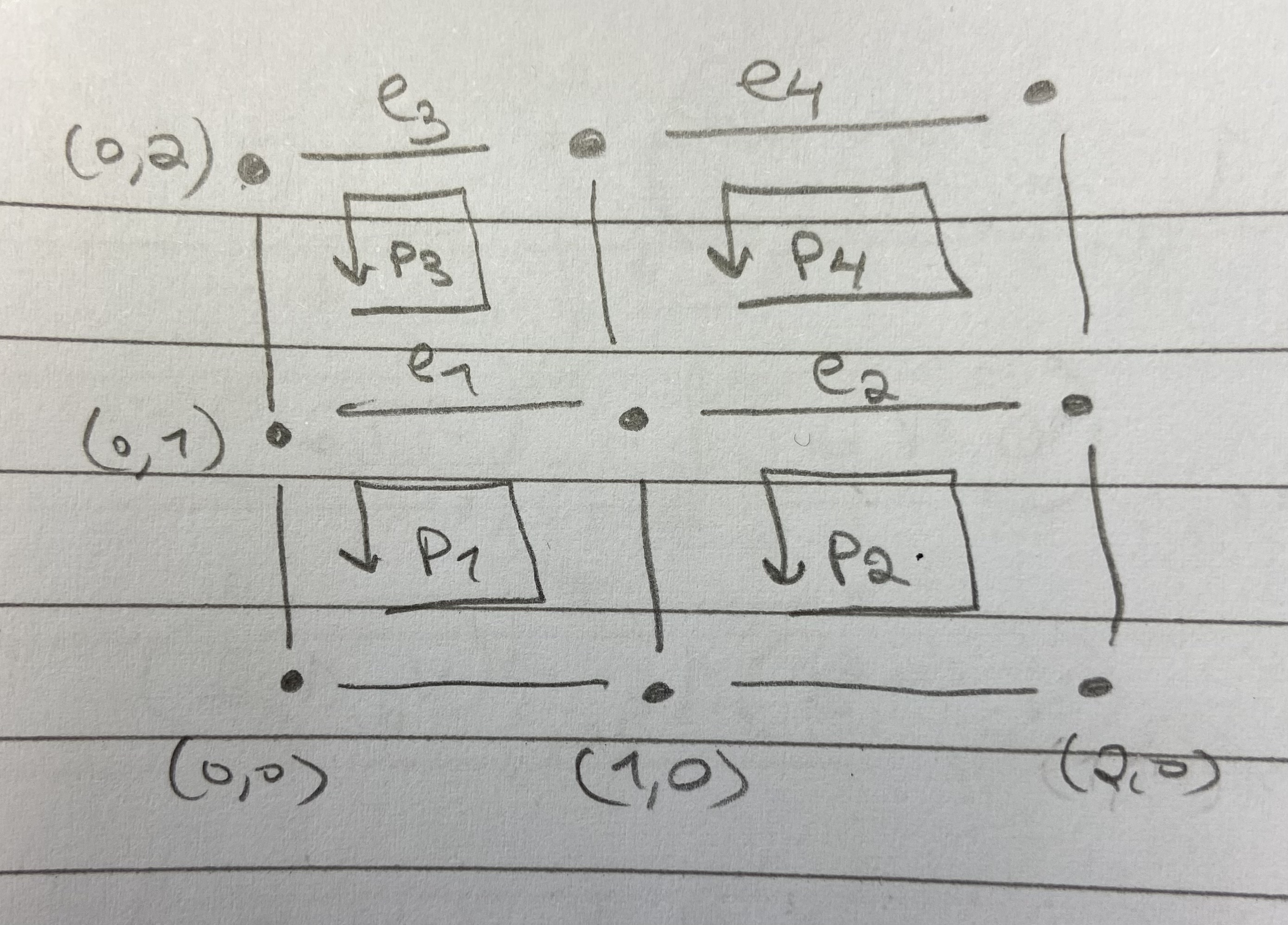
Then \[ l_3^0 = \begin{bmatrix} 2 & 0 & -1 & 0 \\ 0 & 2 & 0 & -1 \\ -1 & 0 & 1 & 0 \\ 0 & -1 & 0 & 1 \\ \end{bmatrix} \] where row \(i\) and column \(j\) has \(l_3^0(e_i,e_j)\), which was an arbitrary way to arrange the matrix, based on the choice of the shorthand notation for the edges in \(E_3^1\).
As an example computation, we have \[\begin{align*} l_3^0(e_1, e_1) &= M_n^0(1_{e_1},1_{e_1})\\ &= 1_{e_1}(p_1)1_{e_1}(p_1) + \cdots + 1_{e_1}(p_4)1_{e_1}(p_4)\\ &= (-1)(-1) + (0)(0) + (1)(1) + (0)(0)\\ &= 2. \end{align*}\]
It is interesting how the edges \(e_3\) and \(e_4\) on the boundary only have one plaquette that gives a non-zero term, where the edges \(e_1\) and \(e_2\) which are in the interior of the box, have two plaquettes, \(p_1\) and \(p_3\), and \(p_2\) and \(p_4\), respectively, whcih give a non-zero term in the quadratic form on the diagonal.
February 12, 2026
For \(x \in (-1,1)\), we know that \[ \log(1-x) = - \sum_{i=1}^{\infty} \frac{c^i}{i}. \]
Also, in functional analysis, bounded operators from one Hilbert space to another can be viewed as points in a Banach space.
Using this abstraction, would we define, treating \(L: \mathcal{H} \to \mathcal{H}\) like \(x\) as above,
for \(\lVert L \rVert_{op} \in (-1,1)\), the following? \[
\log(1-L) = - \sum_{i=1}^{\infty} \frac{L^i}{i}
\]
Or more useful could be the following. For \(c \in (0,2)\) we know that \[ \log(c) = -\sum_{i=1}^{\infty} \frac{(1-c)^i}{i} = \sum_{i=1}^{\infty} (-1)^{i+1} \frac{(c-1)^i}{i}, \] so would we then define for \(\lVert L \rVert_{op} \in (0,2)\), that \[ \log(L) = \sum_{i=1}^{\infty} \frac{(-1)^{i+1}}{i} (L-I)^i, \] where \(I\) denotes the identity operator?
February 8, 2026
The following post is regarding Brennecke (2026).
In (3.14), we have for \(f \in S(\mathbb R^4)\) that \[ \phi(f) = \sqrt{2 \pi} \int_{S_m^+} \lambda_m(dp) \tilde{f}(p) a_p + h.c. \] Straying slightly from the exact formulation (2.21), which is over \(\mathbb R^4\) instead of the mass shell, let us identify \[ a(g) = \int_{S_m^+} \lambda_m(dp) \overline{g}(p) a_p. \] This suggests to write, \[ \phi(f) = a(\sqrt{2 \pi} \overline{\tilde{f}(\cdot)}) + h.c. \] But then the issue is that \(\sqrt{2 \pi} \overline{\tilde{f}(\cdot)}\) is a Schwartz function on \(\mathbb R^4\), and in this setting, we want annihilation operators to be defined by \(L^2(S_m^+)\) functions.
Does it work to simply write (?): \[ \phi(f) = a(\sqrt{2 \pi} \overline{\tilde{f}(\cdot)}|_{S_m^+}) + h.c. \] where \(\sqrt{2 \pi} \overline{\tilde{f}(\cdot)}|_{S_m^+}\) denotes the restriction to \(S_m^+\)?
February 4, 2026
In this section I want collect short summaries of ideas and arguments from the Wightman axioms. I’ll just write a bunch of short little paragraphs. I want to be tolerant of mistakes. In particular, I want to make mistakes and not over-verify that things are correct.
Let me start with the state transformation law for the Wightman axioms. The main idea is that you collect a Hilbert space \(\mathcal{H}\), a representation \(U\) of the covering group of the Poincaré group, and a vacuum state \(\Omega\). But the mathematically demanding part is to invoke self-adjoint operator theory to obtain the 4-momentum \(P\), and to use ideas from special relativity to
One establishes a Hilbert space of states \(\mathbb H\). Then the state transformation law with regards to change of reference frames is given WLOG by an ordinary representation of the inhomogeneous \(SL(2, \mathbb C)\). So we can just write \(U(a,L(A))\) for \((a,A)\) in the covering space.
We can obtain one coordinate of the 4 momentum \(P\) by partial diffentiating the strongly continuous family of unitary operators \(U(a,L(1_{\mathbb C^{2 \times 2}}))_{a \in \mathbb R^4}\) at \((0,0,0,0)\) and multiplying by \(i\).
Notes:
- Note that for lifing the representation \(U(\cdot, \cdot)\) of \(\mathcal{P_+^\uparrow}\) to the cover \(\mathbb R^4 \rtimes SL(2, \mathbb C)\) with the covering map \(L: SL(2, \mathbb C) \to \mathcal{L}_+^{\uparrow}\), I can just think of the equation \[ U(a,(\cdot)) \circ L(\cdot) = \tilde{U}(a,(\cdot)) \] on the covering space \(SL(2,\mathbb C)\).
- To see the difference between direct product and tensor product, form a basis of \(\mathbb R^2 \oplus \mathbb R^3\) by concatenation, but form a basis of \(\mathbb R^2 \otimes \mathbb R^3\) by forming all combinations of elementary elements \(e_i \otimes e_j\) for \(i \in \{1,2\}\) and \(j \in \{1,2,3\}\).
February 2, 2026
Here is a list of “high-level” questions that will guide me as I try to learn the contents of Brennecke (2026).
Questions:
How is the analytic structure of the Poincaré group or its covering group used? Does this relate to the Laplace transform?
What is known about the Laplace transform?
What is the connection between the Laplace transform and Wightman functions? Can I write down a rigorous statement that frames Wightman functions as boundary values of holomorphic functions, and relate this to the Laplace transform?
Why is a Haar measure needed in section 3.2?
Is it true that I can safely ignore the unitarian trick in Section 1.2?
Can I state a precise definition of the covering group of the Poincaré group together with group laws, and say how one lifts projective representations of the Poincaré group to unitary representations of its covering group?
Some sections describe explicit formulas for representations of the Poincaré group on the space of wave functions. See Section 3.1 for example. Is there some result that says whether these formulas are canonical or general?
At some point, Brennecke said that we have classified all finite dimensional irreducible representations of \(X\) group on \(Y\) vector space. What are \(X\) and \(Y\)? What is the precise result or statement? Is this connected somehow to the transformation behavior Wightman axiom or the regularity of the field Wightman axiom?
What are some of the basic definitions involving spin? For instance, recall \(\prod\), \(S\), etc.
What is the role of the parity operator? What even is it?
Is there a bridge between the following three lands: the land of distribution theory, the land of operator theory (Fock space, spectral theorem, quantum mechanics, quantization, unitary dynamics), and representation theory?
Answer to Question 1
It seems the analytic structure of the covering group of the Poincaré group is used in the proof of Lemma 3.11. Basically, one analyzes the Lie algebra of \(SL(2, \mathbb C)\) in order to find finite dimensional irreducible representations of \(SL(2,\mathbb C),\) but one needs an extra lemma regarding a local diffeomorphism property of an exponential map from Lie algebra to Lie group, which requires a smooth structure on \(SL(2, \mathbb C)\) (the Lie group in this case).
Such an analytic structure does not appear to be related to the Laplace transform or any of its related support requirements in QFT.